Nachos, NIMBYs, and Nostalgia
The case for Sneaky Dee's

Once upon a time, I went to school for policing.
I know.
I was 17 and I had no idea what I wanted to do with my life and walking into a Business program fresh out of high school after struggling with math my entire life wasn’t exactly inspiring, so I walked out.
Instead, I enrolled in policing.
I finished the program, but I hated it. Most of the instructors seemed miserable, they made the profession sound depressing, and all their stories seemed to end with somebody divorced, burnt out, or dead. It didn’t sell me on the future. The funny part is that fifteen years later I went back to school for Civil Engineering and discovered I wasn’t bad at math. I was just bad at the wrong math. Shoutout to my wife, Nicole, for handling the finances and Excel while I figured out algebra and physics.
But I digress.
While I was in school for policing, I worked security. I wore an oversized yellow jacket and stood sentry at banks around the city reading books. I looked like a giant yellow lollipop and was about as useful as one. One of those assignments was at a bank at Bathurst and College.
For hours I’d stand there reading The Hitchhiker’s Guide to the Galaxy and staring out the window at Sneaky Dee’s. Somehow, despite playing in punk bands, metal bands, 2-man novelty bands, and spending my youth chasing shows across the GTA, I never went inside.
Part of it was feeling like a fraud. Part of it was feeling insane about walking into Sneaks in a fluorescent yellow jacket with DILDO SECURITY written on the back. Mostly, though, I just figured there would always be another chance.
Then 2025 rolled around. I started Spin Class Local and finally made it through the doors to see Spring Colours play.
For most of my life, Sneaks wasn’t just a venue, it was a landmark.
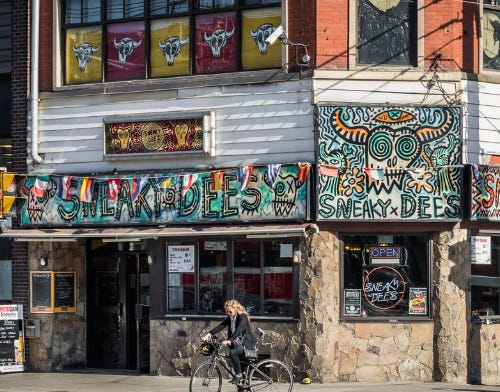
Back when I was taking the YRT into the city from Richmond Hill and transferring onto the TTC to catch shows at the Kathedral, Reverb, Riley’s, the Big Bop, or the Rockit; Sneaky Dee’s was always there.
My friends in Skullians practically lived there.
For local bands, it was one of those venues that existed in a different category. A place you aspired to play. It felt important even if you’d never went inside. And now, after all that, it feels like we’re running out of time.
Especially because of the nachos.

Here’s where I might lose some people.
My day job is in planning, and from where I sit, this doesn’t have to be a choice between housing and culture. Municipalities negotiate with developers every day, and not necessarily to the benefit of the community. Amenities are added, public land gets sacrificed for profit, affordable housing targets change, parkettes move and daycares become retail space. It’s an imperfect process, but negotiation is part of development.
The City has more tools available to it than simply approving a project and hoping for the best.
So, let’s look at the options.
Scenario One: Do nothing.
Sneaky Dee’s disappears. Toronto loses another independent venue. Local artists lose one of the few remaining medium-sized stages in a central location. Another piece of music history becomes a story people tell newcomers about what used to be here.
Scenario Two: Require Sneaky Dee’s to be incorporated into the new development.
The condo still gets built. Maybe the developer loses a gym. Maybe a pool. Maybe they lose some other amenity that residents barely use after the first six months. The community keeps Sneaks and residents gain a bar and music venue in their building. The neighbourhood keeps a cultural institution. Everybody gets something.
Scenario Three: Require the developer to build a replacement venue elsewhere as part of the project.
There’s an underused parking lot directly across the street. Imagine a purpose-built Sneaky Dee’s there instead, and with Toronto moving swiftly into the next class of urban center, we need less space for cars. it would be the same neighbourhood, same community, same function. Different building.
I’m not pretending any of these solutions are simple. I’m also not implying I know exactly how heritage designation works or what legal mechanisms are available. What I do know is that Toronto has found ways to preserve cultural spaces before.
The Silver Dollar Room isn’t the Silver Dollar Room of twenty years ago, but it survived. It’s now called Dina’s and people show up. New artists still play there; new memories are made.
There’s another piece of this conversation that often gets overlooked: accessibility.
I love old venues but a lot of them were built in a different era and it shows. The El Mocambo and Dina’s have found a second life in spaces that more people can equitably access. Bigger entries, wider hallways, wheelchair accessible bathrooms at grade, not stowed away or ignored.
A rebuilt Sneaky Dee’s would have to meet modern building standards. It could be more accessible for fans with mobility challenges, easier for artists to load into, safer for staff, and more welcoming to people who wouldn’t have felt comfortable navigating a steep staircase or structurally precarious floor.
Preserving culture shouldn’t just mean preserving it for the people who already have access to it. It should mean opening the door to the next generation of fans, artists, and community members too.
If Sneaks gets a second life, I’d like to think more people would get the chance to experience what makes it special.
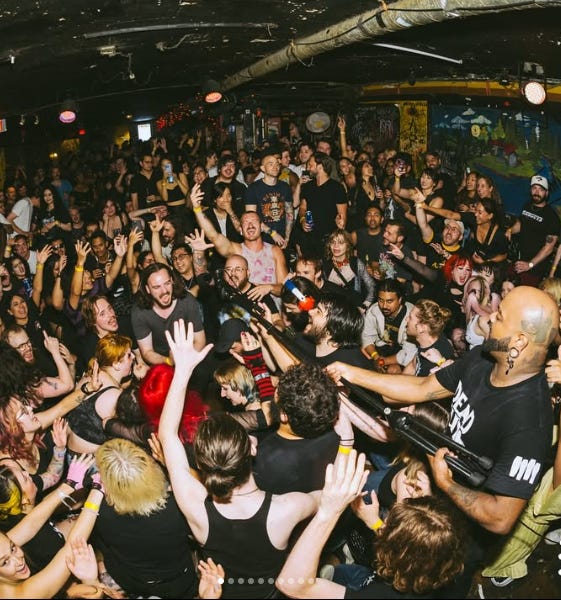
What bothers me most about this conversation is that too many people are acting like the only options are total preservation or total demolition.
They aren’t.
If the City truly believes music and culture are part of Toronto’s identity, then surely there is room for creativity here. I don’t claim to know the perfect solution. I just know the City has more options than standing by and watching another venue disappear.
If I could snap my fingers and make one decision, it wouldn’t be to stop building housing.
It would be to make sure Sneaks has a future in whatever gets built next.